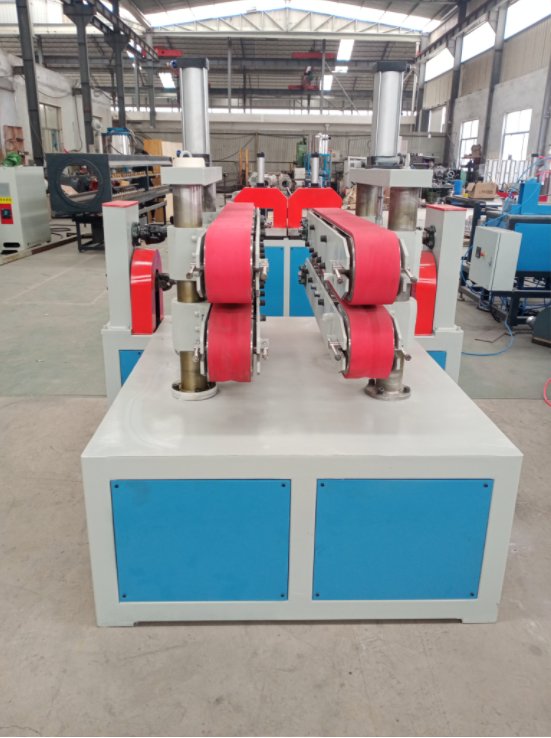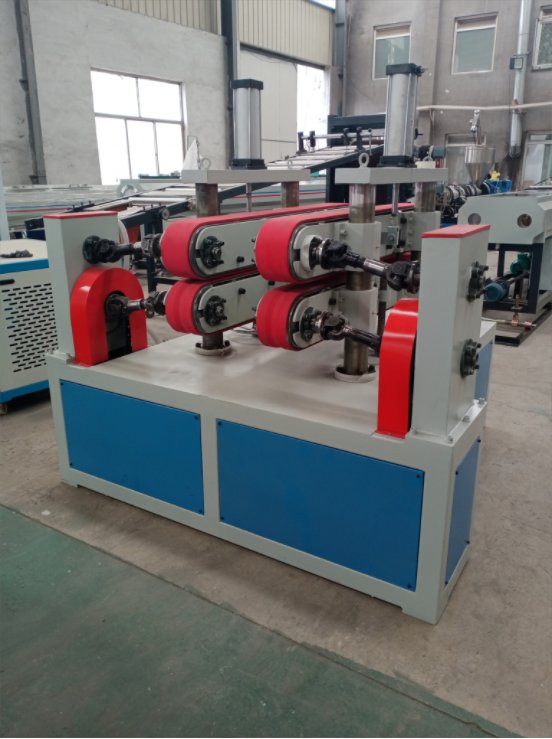


In today’s plastic pipe extrusion industry, equipment stability has become a key factor that directly affects product surface quality and production efficiency. To meet the market’s higher quality demands, we have fully upgraded the haul-off section of our pipe production lines—replacing the traditional crawler-type haul-off with the new belt-type haul-off system.
Many customers may not know that when a pipe first comes out of the die head, small fluctuations naturally occur due to melt flow and extrusion stability. If the haul-off system does not grip the pipe smoothly or fails to follow these subtle movements, such small vibrations can be amplified, resulting in surface marks, uneven dimensions, and other quality issues.
The newly adopted belt haul-off technology is designed to solve exactly this industry challenge.
The belt structure provides stronger coverage and more even pressure distribution. When it contacts the pipe, it adapts to the pipe’s shape and movement more gently, effectively absorbing and reducing tiny vibrations during extrusion. Compared with the traditional crawler system, the belt haul-off runs more smoothly, maintains stable line speed even at higher production speeds, and ensures better pipe surface quality and more consistent dimensions.
This upgrade not only improves product quality but also enhances production efficiency. With better stability in the haul-off process, adjustment time is reduced, the defective rate drops, and the entire production line performs more reliably during long-term operation.
Technological progress often comes from subtle optimizations, and this new generation belt haul-off system is a perfect example of how small details can produce major improvements in production results. As more factories adopt belt-type haul-offs, the overall quality standards of the pipe extrusion industry will continue to rise.
There is still more room to explore—such as belt materials, pressure control systems, and synchronization design—showing that the next stage of haul-off innovation has already begun.